Humanity’s most powerful ground-based sky survey just produced its first images — millions of galaxies, sprawling nebulas, and deep-universe data captured in a single frame. The timing makes what comes next all the more pressing.
The NSF-DOE Vera C. Rubin Observatory, perched atop Cerro Pachón in Chile, released those first portraits in June 2025. Fitted with the world’s largest digital camera and a telescope with an unusually wide field of view, the facility is designed to image the entire night sky repeatedly, building a decade-long record of the observable universe. “We’re going to actually create more data than all optical astronomy has ever had in the first year of our decade of operations, which absolutely blows my mind,” said Meredith Rawls, an astronomer working on the observatory, speaking at January’s American Astronomical Society meeting.
One scientist at that same conference called the early imagery “astro-cinematography.” The description fits: the frames are dense with information, capturing what the announcement says are roughly 10 million galaxies in a single exposure.
The Satellite Problem
That ambition now runs directly into a collision with commercial spaceflight. There are approximately 14,000 satellites currently orbiting Earth — nearly 10,000 of them belonging to SpaceX alone. That number is set to climb sharply. Blue Origin, Eutelsat’s OneWeb, several Chinese companies, and smaller startups are all expanding or preparing their own orbital networks. SpaceX has floated the concept of an orbital data center that would involve placing something in the range of one million additional satellites in orbit.
For Rubin, these objects leave streaks across long-exposure images — visible light trails that corrupt astrophotography data. The problem is not hypothetical. Satellite interference with ground-based telescopes is already well-documented, with existing instruments like the Gemini North Telescope already producing affected imagery.
The stakes extend beyond science. Federica Bianco, a scientist with the University of Delaware, addressed the issue directly at the conference. “Astrophotography is a valuable educational tool for raising awareness and interest in the natural world,” she said. “The night sky environment is often culturally significant, and dark sky tourism has been recognized as an important factor in sustainable development of rural and remote communities.”

A Broader Impact
The concern is not limited to astronomers. This month, physicians and scientists from Northwestern University announced they are worried that the growing number of satellites in Earth orbit could disrupt human sleep patterns. The orbital environment, in other words, is no longer only a scientific question.
“They change the night sky,” Rawls said plainly.
Rubin’s images are already being assessed for satellite streak contamination, according to the report, with the observatory’s team actively working to identify and account for the interference in its data pipeline.
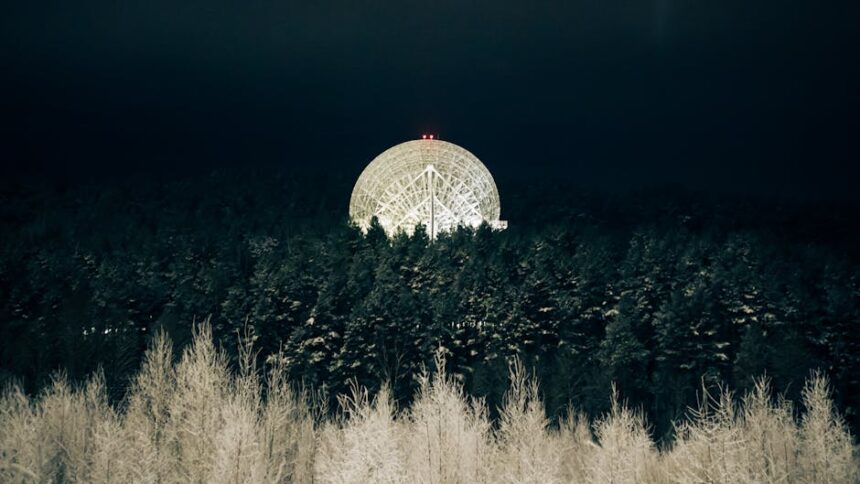
Photo by Stanislav Kondratiev on Pexels
This article is a curated summary based on third-party sources. Source: Read the original article