The moon Hyperion has puzzled planetary scientists for years. It orbits Saturn looking freshly made, far younger than the ancient moons surrounding it. According to new research, that age gap may be a scar left by a violent collision roughly 400 million years ago — one that reshaped the entire Saturnian system in a single chain reaction.
The hypothesis centers on Titan, Saturn’s largest moon, and a now-vanished body called Chrysalis. Chrysalis was first proposed in 2022 to explain why Saturn’s axial wobble is not locked to Neptune‘s gravitational influence, as simulations had long predicted it should be. The original idea held that Chrysalis drifted too close to Saturn, broke apart, and scattered into the rings — simultaneously freeing the planet’s wobble and warping the tilted orbit of the small moon Iapetus.
There was a problem with that picture. When Matija Ćuk at the SETI Institute in California and his team ran the simulations, Chrysalis kept hitting Titan instead. “If there was a collision with Titan, it could not have become the rings,” Ćuk says. So rather than discard the scenario, the team calculated what that collision would actually produce.
One impact, many consequences
The results, according to the announcement, suggest a collision between proto-Titan and Chrysalis would have done several things at once. It would have erased Titan’s craters, explaining why the surface shows strangely few of them today. It would have pushed Titan’s then-circular orbit into the elongated, eccentric path it currently follows. And it would have thrown off a spray of debris — debris that may have coalesced into Hyperion, accounting for that moon’s anomalous youth.
The cascade did not stop there. Over time, Titan’s newly elliptical orbit gravitationally destabilised the small inner moons, sending them into each other. Those collisions ground the moons down into the fine particles that now form Saturn’s iconic rings. “It all starts from Titan and then trickles down to a second catastrophe in the inner system,” Ćuk says.
The scenario offers a single origin story for several disconnected oddities: the rings’ apparent youth, Saturn’s decoupled wobble, Iapetus’s tilted orbit, Titan’s scarce craters, Titan’s eccentric path, and Hyperion’s relative newness. “This is sort of a grand unified theory that covers all of the major problems,” Ćuk says. “We had some idea about each of them, but this might be how they relate in one story that can be tested.”

What comes next
Sarah Hörst at Johns Hopkins University in Maryland called the framework elegant. “If a collision with Titan 1.0 can explain many other things about the Saturn system, then I think that would really centre Titan as being pivotal to how we see the system today,” she says.
A test is coming. NASA‘s Dragonfly mission is scheduled to launch in 2028 and reach Titan in 2034. A close examination of the moon’s surface should reveal whether the chemical and geological fingerprints of a merger with Chrysalis are actually there.
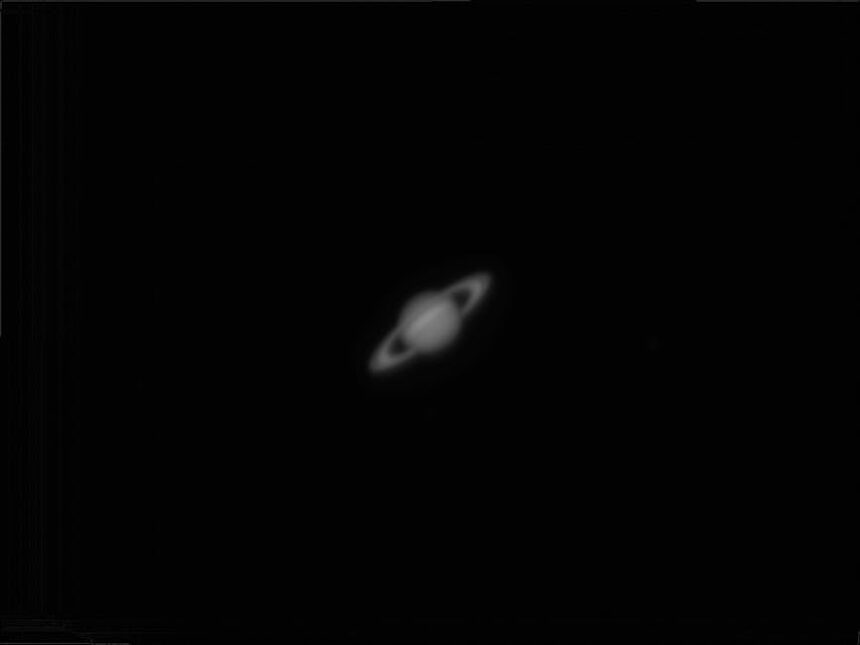
Photo by Sheken Astro on Pexels
This article is a curated summary based on third-party sources. Source: Read the original article