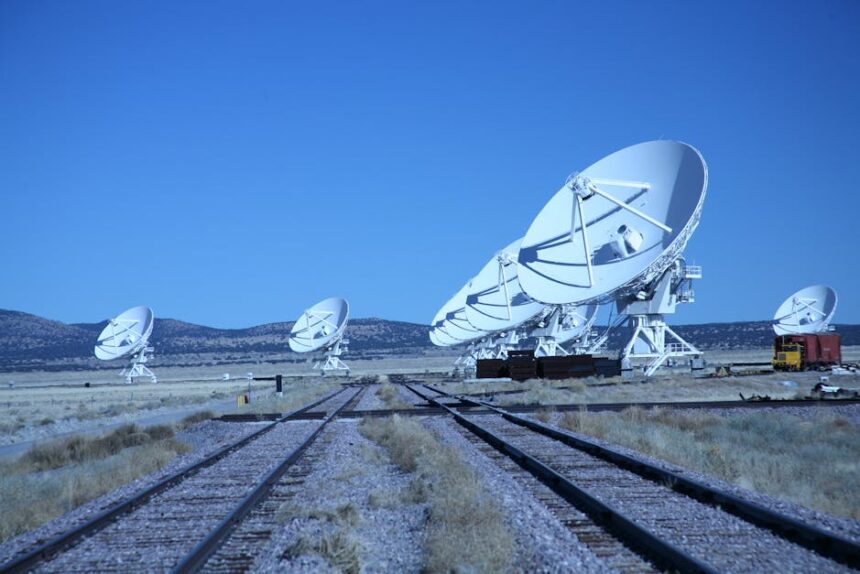
The Allen Telescope Array in Northern California has spent years scanning the sky for narrowband radio signals — the kind that, in theory, only an intelligent civilization would produce. It has found none. A new study from the SETI Institute suggests one reason the searches keep coming up empty may have nothing to do with the absence of alien transmitters, and everything to do with what happens to a signal before it ever leaves its home star system.
The culprit, according to the study, is diffractive scintillation. When a narrowband radio signal passes through plasma ejected by its host star — through stellar winds or coronal mass ejections — the plasma smears the signal across a wider range of frequencies. That spreading dilutes the signal’s power. A transmission that began tightly constrained to a few hertz of bandwidth can arrive, if it arrives at all, too faint and too broad for current detection methods to flag it.
“SETI searches are often optimized for extremely narrow signals,” said Vishal Gajjar, of the SETI Institute in Mountain View, California. “If a signal gets broadened by its own star’s environment, it can slip below our detection thresholds, even if it’s there, potentially helping explain some of the radio silence we’ve seen in technosignature searches.”
Why narrowband signals matter
The logic behind searching for narrowband signals is straightforward. Nothing known in nature generates a radio signal constrained to just a few hertz of bandwidth. If one were detected, the artificiality would be nearly self-evident. SETI researchers also already account for a related phenomenon — electron dispersion in the interstellar medium between stars, which causes lower radio frequencies to arrive later than higher ones, distorting broadband signals enough to make them nearly unreadable across vast distances. Narrowband signals sidestep that problem.
What no one had done before this study was quantify the disruption caused by space weather within a transmitting civilization’s own stellar system — the plasma environment closest to the source.
Calibrating the effect
To measure it, Gajjar and his SETI Institute colleague Grayce Brown worked from data closer to home. They analyzed how fluctuations in the solar wind and bursts from solar coronal mass ejections affect narrowband signals traveling between Earth and spacecraft operating inside our solar system. By averaging those effects over time, they produced a calibrated model of how much broadening our own sun introduces.

That model then became the baseline. The pair applied it to two other stellar types, extending the calculation beyond our own neighborhood to estimate how space weather around different kinds of stars might degrade transmissions from any technological species unfortunate enough to orbit them.
The practical implication is that detection algorithms tuned exclusively for the sharpest, cleanest narrowband signals may be systematically missing transmissions that exist but have been degraded in transit. Quantifying the broadening effect, the study argues, is the first step toward building search strategies that can compensate for it — catching signals that currently slip past unnoticed.
Photo by Ray Strassburger on Pexels
This article is a curated summary based on third-party sources. Source: Read the original article