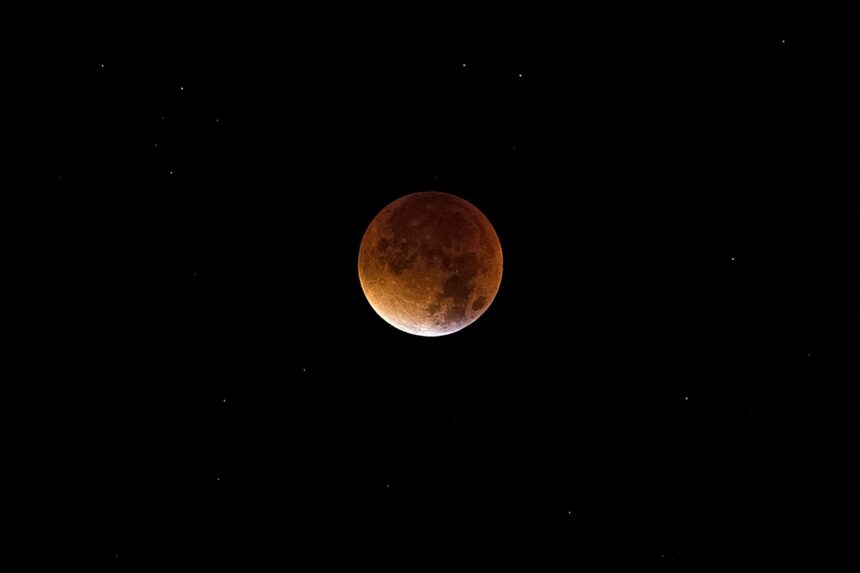
Skywatchers have spent weeks anticipating this year’s most dramatic lunar event, and on the night of March 3, it delivered.
A total lunar eclipse swept across the sky, pulling the full moon through the deepest part of Earth’s shadow and turning it a deep, rusty red. The phenomenon — commonly called a blood moon — occurs when Earth positions itself directly between the moon and the sun during a full moon phase. With no direct sunlight reaching the lunar surface, the moon instead catches light that has traveled through Earth’s atmosphere, which strips out shorter blue wavelengths and lets the longer red ones pass through.
Who Saw It and From Where
Totality was visible across large portions of the Americas, Asia, and Oceania. Photographers fanned out across the region, producing a striking record of the event from multiple vantage points.
In Auckland, New Zealand, photographer Phil Walter captured the partial phase — Earth’s shadow beginning its slow creep across the western edge of the lunar disk. Viewers in the southern hemisphere see the moon oriented opposite to what northern hemisphere observers expect, a geographic quirk that gives images from that region a distinctly different feel.
From Manila, Philippines, Ted Aljibe photographed the moon glowing orange near the horizon. According to the report, that color was not produced by the eclipse itself but by the moon’s low position in the sky — its reflected light traveling a longer path through Earth’s atmosphere at that angle, scattering blue wavelengths and leaving the image saturated in orange.
Minutes later, Fred Lee photographed the same moon from Beijing, China. One image captures a thin crescent of sunlit lunar surface just before totality, with the city skyline stretched out below. The darkened portion of the disk was already faintly lit by sunlight refracted through Earth’s atmosphere — enough to make the lunar maria, the ancient basalt plains formed from cooled lava, visible to the naked eye. A separate wide-angle shot from Lee shows the lunar sea Mare Crisium — the Sea of Crisis — as a dark circular feature on the sunlit disk, its surface the hardened remnant of lava that flooded a network of impact craters more than a billion years ago.

The Science Behind the Color
The blood moon effect is a direct product of atmospheric filtering. Earth’s atmosphere scatters blue light efficiently while allowing red wavelengths to pass with relatively little interference. During totality, that filtered red light is the only illumination reaching the lunar surface, casting the disk in shades ranging from deep copper to bright crimson depending on atmospheric conditions at the time.
The event drew widespread attention precisely because total lunar eclipses require no special equipment — the transformation is visible to the naked eye from anywhere on the night side of Earth where skies are clear.
A full recap of the event is available through the total lunar eclipse live blog, according to the announcement.
Photo by Pixabay
This article is a curated summary based on third-party sources. Source: Read the original article