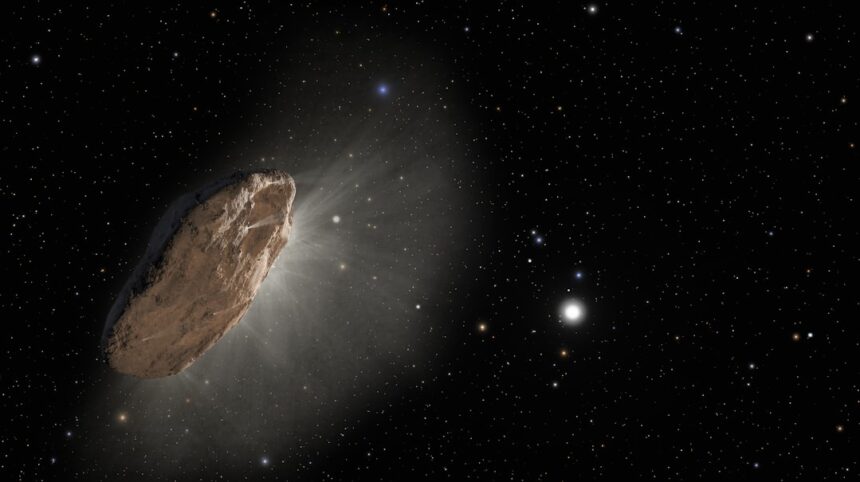
TransAstra, a Los Angeles-based startup, says an unnamed customer has agreed to fund a feasibility study for a mission to capture a near-Earth asteroid roughly the size of a house and tow it to a fixed point near our planet.
The proposed “New Moon” mission would deploy a large flexible bag around an asteroid with a mass of approximately 100 metric tons and relocate it to the Earth-Sun L2 point, about 1.5 million kilometers from Earth. According to the announcement, the study will be completed by May, with a full mission potentially reaching an asteroid as early as 2028 or 2029 if funding follows.
“We envision it becoming a base for robotic research and development on materials processing and manufacturing,” said Joel Sercel, chief executive of TransAstra. “Long term, instead of building space hardware on the ground and launching propellant up from the Earth, we could harvest it from raw materials in space.”
Capture Bag Technology
The capture bag is not a concept drawing. Last September, a 1-meter prototype flew to the International Space Station aboard a Cygnus spacecraft, where an astronaut deployed it inside the Bishop airlock and successfully opened and closed it in vacuum conditions. That same fall, TransAstra received a $2.5 million NASA contract to scale the system to 10 meters in diameter — the size the company says is needed to corral small asteroids. Private funding matched the NASA award, accelerating development of the larger bag.
The bags are made from laminates including Kapton, designed to expand around a target body and allow it to be towed.
Sercel says there are as many as 250 potential target asteroids, each up to roughly 20 meters in diameter, reachable by reusable robotic spacecraft over the next decade. The company envisions aggregating dozens, then hundreds, of such bodies at the processing facility. Targets would be selected by composition — C-type asteroids for water usable as propellant, M-types for metals, with minerals potentially sourced for solar panels and radiation shielding.

Scale of the Ambition
NASA’s OSIRIS-REx mission returned to Earth in 2023 carrying 121.3 grams of material from the asteroid Bennu at a cost of more than $1 billion. TransAstra is proposing to return vastly more mass for what Sercel described as “a few hundred million dollars.”
The company has not yet selected a spacecraft provider. Sercel said the firm is “studying the entire industrial base” of U.S. providers, assessing performance and cost, with the unnamed customer making the final selection later in the process.
TransAstra is working with the University of Central Florida, Purdue University, and JPL/Caltech on the feasibility analysis.
Photo by NASA Hubble Space Telescope on Unsplash
This article is a curated summary based on third-party sources. Source: Read the original article