The mandrill keeps its blues and reds only where fur is absent. That detail, small as it sounds, captures everything about why mammals lost the color game hundreds of millions of years ago — and never fully recovered.
Matthew Shawkey, an evolutionary biologist at Ghent University in Belgium, explains that animals produce color through two main routes: pigments embedded in skin or coat, and structural coloration — nanoscale patterns on feathers, scales or skin that bend light into bright, iridescent hues. Birds, reptiles and fish exploit both. Mammals, according to Shawkey, use neither effectively.
The pigment problem is stark. Where other animals draw from a wide palette — carotenoids, porphyrins, pterins — mammals carry exactly one pigment type: melanin. Every color visible on a mammal’s body, from the black stripes of a zebra to the brown coat of a bear, comes from that single molecule. The white patches on pandas and zebras arise from its absence.
Hair Is the Limiting Factor
Structural color is equally out of reach. Feathers and scales are architecturally complex enough to generate the nanoscale patterns that scatter and distort light. Hair is not. Its comparatively simple structure makes those patterns impossible to form. Mandrills (Mandrillus sphinx), among the few mammals that display vivid color, carry their red and blue pigmentation only on bare facial skin — not on fur. Sloths, which occasionally show green patches, owe that color to algae colonizing their coats, not to anything the hairs themselves produce.
The deeper question is how mammals arrived at this point. One hypothesis, supported by a 2025 study published in the journal Science and co-authored by Shawkey, traces the problem back more than 100 million years. When early mammals evolved, nonavian dinosaurs were the dominant predators. Mammals survived largely by being nocturnal, keeping to the dark to avoid becoming prey. That behavioral adaptation carried a biological cost.
What 100 Million Years of Darkness Did
The study compared pigment-storing structures called melanosomes in living mammals against preserved melanosomes recovered from six fossils spanning the Jurassic and Cretaceous periods. Every fossil came back some shade of brown or gray. Dark coloration offered camouflage in low-light environments. “Any bright color would have been selected against,” Shawkey said.

Since nonavian dinosaurs disappeared roughly 66 million years ago, mammal diversity has expanded to more than 6,000 species. Many now face no natural predators. Yet the palette has barely shifted. Ted Stankowich, cited in the report, points to another constraint: most mammals still lack full color vision. If an animal cannot see color richly, there is little evolutionary pressure to display it. The signal has no receiver, so the trait never develops.
The mandrill remains the exception that clarifies the rule — vivid only where the fur stops, colorful only where evolution found a narrow opening.
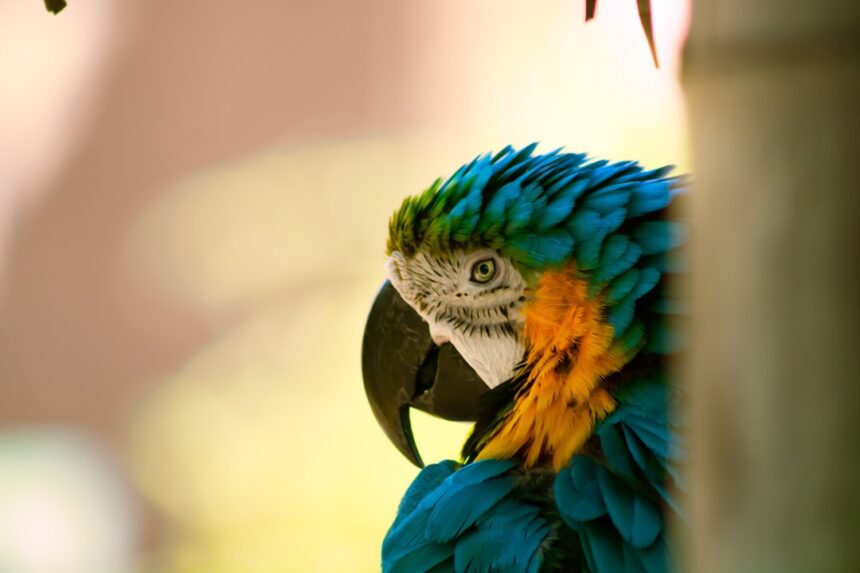
Photo by Jonathan Gong on Unsplash
This article is a curated summary based on third-party sources. Source: Read the original article